Hey everyone, it’s your favorite QC inspector from the hainansourcing frontlines back with another factory floor story. Today, I want to talk about something that gives every importer nightmares: bad packaging.
Last Tuesday, I drove out to a factory to inspect a batch of ceramic tableware for one of our clients. Honestly, when I first walked into the inspection room, I was blown away. The client had ordered these gorgeous, minimalist ceramic plates and bowls with a delicate matte finish and gold-painted rims. They were heavy, high-quality, and completely stunning.
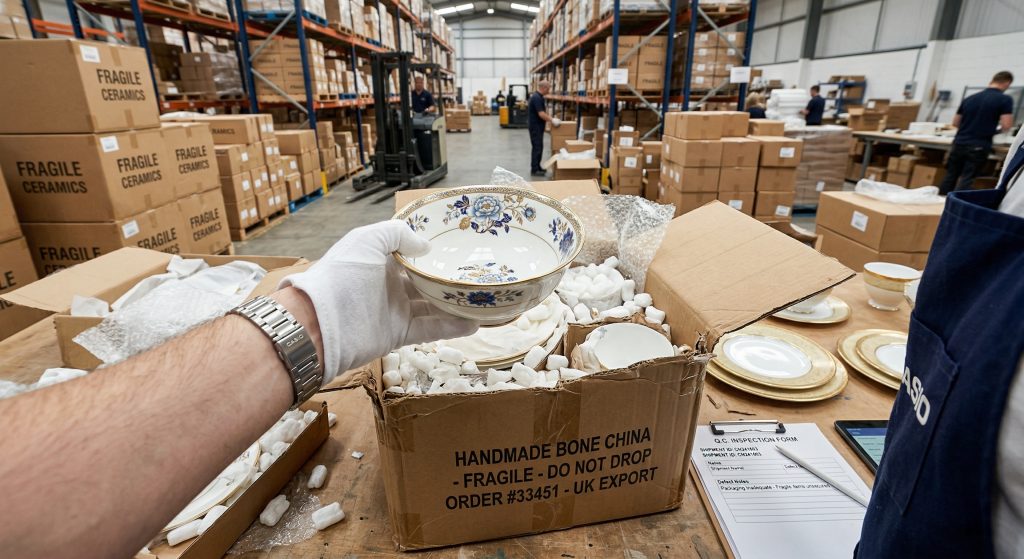
But as a QC inspector, I know that making a beautiful product is only 50% of the battle. The other 50% is making sure it actually survives the brutal 10,000-mile journey across the ocean to the customer’s doorstep.
The factory manager, Mr. Chen, proudly brought out the retail packaging. He handed me a box, and immediately, my “QC spidey senses” started tingling. The outer carton felt surprisingly soft—like it was made of recycled paper that had already given up on life.
I gave the box a gentle shake.
Clink… clack… scrape.
That is exactly the sound you never want to hear when holding a box of expensive ceramics.
I opened it up. The factory had packed these beautiful, heavy plates using only thin, single-wall cardboard dividers and a single sheet of tissue paper between each piece. No bubble wrap. No foam. Nothing to absorb shock.
“Mr. Chen,” I said, trying to keep things light but serious, “If we put these on a container ship, our client is going to receive a very expensive 1,000-piece jigsaw puzzle.”
Mr. Chen laughed nervously and assured me they pack things like this all the time. So, I proposed a simple test: The Drop Test. We packed up a sample box, sealed it, and I dropped it from table height onto the concrete floor.
We opened the box together. Sure enough, the bottom plate had a massive chip on the edge, and one of the bowls was cracked right down the middle. Mr. Chen’s smile completely vanished.
If this had shipped, the client’s return rate would have been catastrophic.
We immediately sat down with the factory’s packaging engineer. I explained that for items this heavy and fragile, thin cardboard just doesn’t cut it. We needed to upgrade the materials before anything went onto a truck.
Here is what we implemented right there on the spot:
- Upgraded Outer Carton: Swapped the flimsy single-wall boxes for rigid, 5-ply double-wall corrugated cartons.
- EPE Foam Inserts: We ditched the paper dividers entirely. Instead, we had the factory cut custom EPE foam (pearl cotton) molds. This stuff is lightweight but dense enough to hold the plates snugly so they physically cannot move or touch each other.
- Drop-Test Requirement: We agreed that the new packaging had to pass a strict ISTA 1A drop test (10 drops from specific angles) without a single scratch.
The factory had to delay the shipment by five days to get the new materials in, but my client was incredibly relieved when I sent them the video of the failed drop test. They happily accepted the delay.
When I went back the following Monday to re-inspect, the difference was night and day. I packed a new box, shook it as hard as I could—dead silent. We dropped it on its corners, its edges, and its flat sides. We opened it up, and every single gold-rimmed plate was perfect.
It’s moments like these that remind me why I do this job. Sometimes, quality control isn’t just about measuring dimensions or checking colors; it’s about looking at a box, shaking it, and saving someone from a massive headache weeks down the line.
Anyway, my coffee is getting cold, and I have a batch of wooden furniture to inspect next. Until next time!