Date: March 26, 2026
Location: On the high-speed train from Changsha to Yongkang (the drinkware capital of China)
Mood: Highly caffeinated. Ready to catch some factory shortcuts.
Let’s be real for a second. The hydration market is booming. Every buyer I talk to wants to source the next viral, aesthetic, ice-keeping tumbler. It looks like a simple product, right? It’s just two pieces of metal welded together with a plastic lid.
Wrong.
As a QC inspector who spends half my life on factory floors staring at sparks flying and smelling hot paint, I can tell you that stainless steel water bottles are engineering minefields. You might approve a gorgeous pre-production sample, but when the container arrives at your fulfillment center, you suddenly have a 15% defect rate and your Amazon reviews are tanking.
Today, let’s open up the diary and talk about the three biggest nightmares buyers face when sourcing double-wall vacuum insulated bottles—and how I catch them on the assembly line.
Nightmare #1: The “Sweating” Bottle (Vacuum Insulation Failure)
The entire selling point of a thermal bottle is that it keeps ice frozen for 24 hours or coffee hot for 12. This magic happens because of the vacuum layer between the inner and outer stainless steel walls. If there is air in that gap, the heat transfers immediately. We call this “losing the vacuum.”
If your end-consumer pours ice water into your premium bottle and the outside starts sweating (forming condensation), your product has failed. Period.
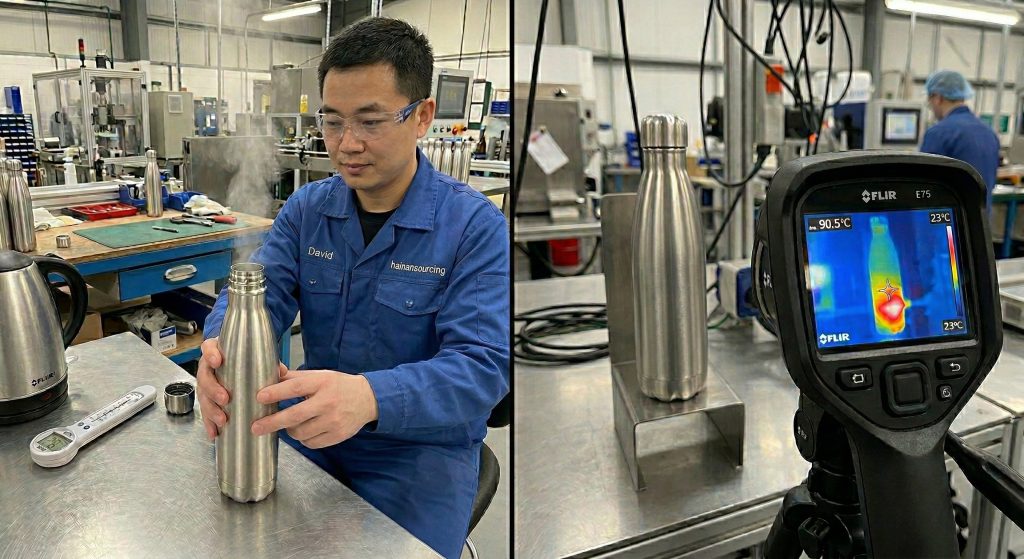
How to avoid this pitfall:
- Check the 100% Temperature Testing Protocol: Every single decent factory should test every single bottle (not just a random batch) for vacuum retention. They do this by shooting hot air or boiling water into the unpainted bottles and letting them sit. Then, workers physically touch the outside of the bottles. If a bottle feels hot, it goes straight to the scrap bin. When I audit a factory, I stand at this station for a long time to see if the workers are actually paying attention or just waving their hands over the bottles.
- The “Getter” Pill: Inside the vacuum gap, factories put a tiny piece of metal called a “getter.” When the bottle is heated in the vacuum furnace, this pill absorbs any remaining trace gases. Cheap factories skip this or use low-quality getters, meaning the vacuum might last a month, but fail by the time it reaches your customer.
Nightmare #2: The Rusting “Premium” Bottle (Material Fraud)
“Hey, why is my 304 food-grade stainless steel bottle rusting at the bottom?”
I hear this complaint all the time. The harsh truth? It probably isn’t 304 stainless steel. In the stainless steel world, 304 (also known as 18/8) and 316 (medical grade) are the gold standards for drinkware because they are highly resistant to corrosion.
However, there is a cheaper, lower-nickel alternative called 201 stainless steel. 201 rusts very easily when exposed to moisture, salt, or acidic liquids (like coffee or lemon water). Visually, 201 and 304 look identical. Some shady suppliers will quote you for 304, but secretly use 201 for the outer shell—or worse, the inner wall—to pad their margins.
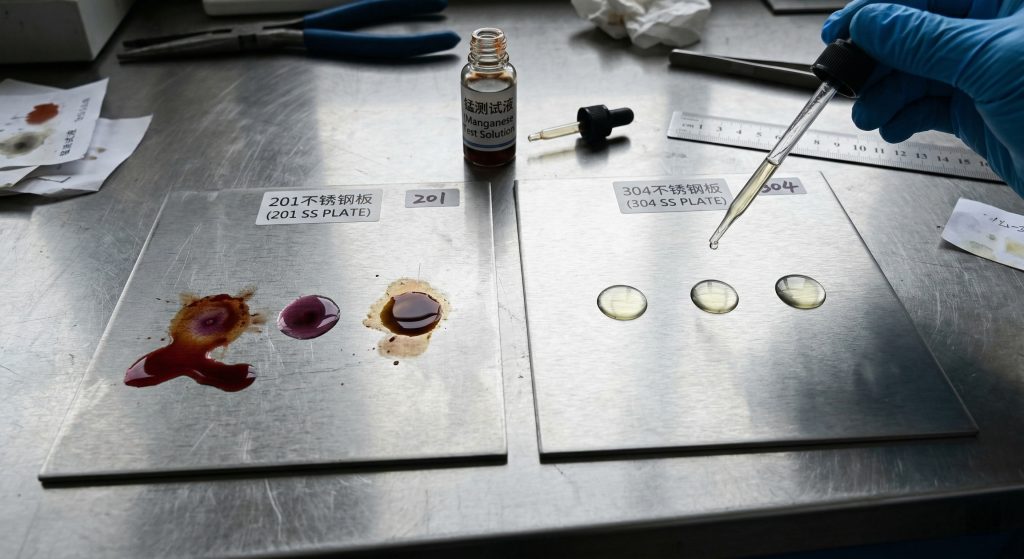
How to avoid this pitfall:
- The Chemical Drop Test: As a QC, I don’t trust paperwork; I trust chemistry. I carry a small bottle of manganese testing liquid (commonly called 304 testing fluid). During a DUPRO (During Production Inspection), I put a drop on the raw steel shells. If it turns red in seconds, it’s 201. If the factory tries to stop me from doing this test, I immediately know something is wrong.
- Specify Parts in the Contract: Make sure your PO explicitly states: “Inner Wall: SUS304. Outer Wall: SUS304.” Don’t just say “Stainless Steel.” Some factories will use 304 inside but sneakily use 201 outside. If the paint gets scratched, the outside will start rusting.
Nightmare #3: The Peeling Masterpiece (Surface Coating Failures)
You spent weeks finalizing the perfect Pantone colors and gradient designs. But after a week of normal use, the paint starts chipping off the bottom, or the logo scratches off with a fingernail.
Surface treatment (powder coating, liquid spray painting, or water transfer printing) is incredibly tricky. If the steel isn’t cleaned perfectly before painting, or if the baking oven temperature fluctuates, the paint simply won’t stick.
How to avoid this pitfall:
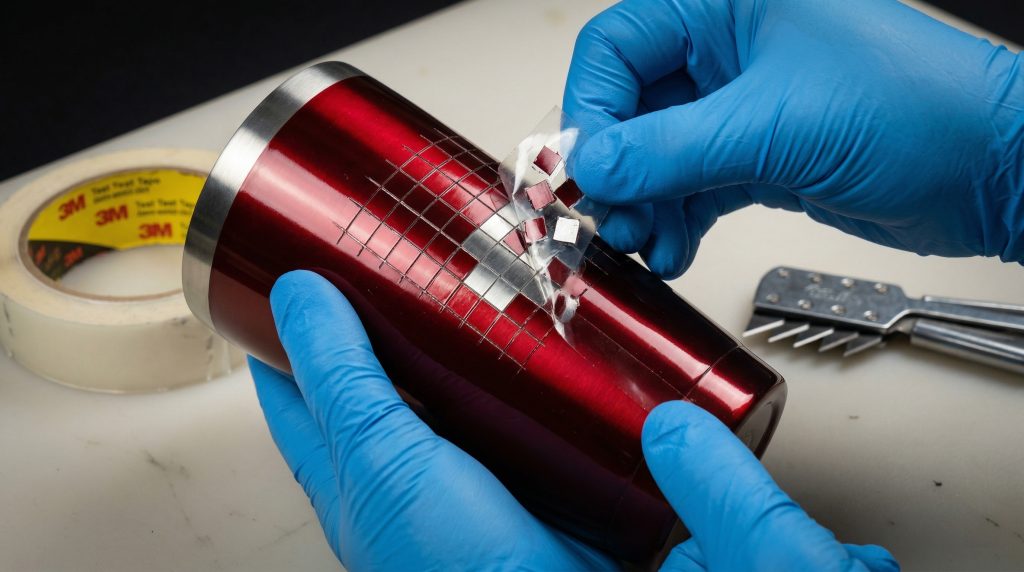
- The Cross-Hatch Tape Test: This is my favorite destructive test. We cut a grid into the paint, apply special 3M tape, rub it down hard, and rip it off quickly. If the paint flakes off in chunks, the adhesion is terrible. Your customers will destroy that paint job in the dishwasher or cup holder.
- Dishwasher Safe Claims: If you are marketing your bottle as “Dishwasher Safe,” you must use high-quality powder coating (not standard liquid paint), and the factory’s pre-treatment (washing the oil off the raw steel) must be flawless. Ask the factory for their third-party dishwasher testing reports for their specific coating line.
A Final Word Before I Arrive at the Factory
Sourcing drinkware is a game of millimeters and degrees. A bad weld, a skipped cleaning wash, or a swapped material can ruin a whole container.
When you are negotiating with suppliers on Alibaba or at trade shows, remember this: If a factory’s price is 20% lower than the market average for a 304 insulated bottle, they are cutting a corner somewhere. They aren’t doing it out of the goodness of their hearts. They might be using thinner steel (making it dent easily), skipping the getter pill, or mixing in 201 steel.
Don’t let a 50-cent saving at the factory cost you a $30 refund and a 1-star review on Amazon.
Alright, the train is pulling into Yongkang South Station. Time to put on my steel-toed boots, grab my testing kit, and go see what this factory is really made of.
Keep Sourcing, Keep Safe!